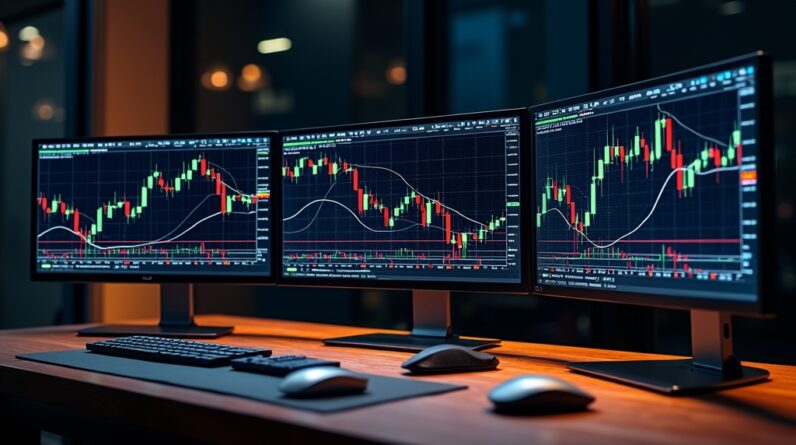
Are you ready to supercharge your trading? 🚀 Here are the top five indicators you should know:
- Moving Averages (MA) – Smooth price changes over time!
- MACD – Spot trend reversals with a nifty crossover!
- RSI – A quick glance at overbought or oversold levels (70/30 magic numbers!).
- Stochastic Oscillator – Perfect for confirming those buying or selling vibes!
- Bollinger Bands – Identify price breakouts and get ready to surf the waves! 🌊
Keep that curiosity flowing to uncover even more trading secrets!
- Moving Averages (MA): These smooth out price fluctuations. Think of MAs like a warm fuzzy blanket for your trading charts! They help you spot market trends by averaging currency prices over time. There are two types: the Simple Moving Average (SMA) gives equal weight to all prices, while the Exponential Moving Average (EMA) shouts louder for recent prices. This makes EMAs super useful for spotting quick trends!
- Next up, we have the Moving Average Convergence Divergence (MACD). This savvy indicator detects trend strengths and reversals like a hawk! When the MACD line crosses above its signal line, it’s a buy signal! If it crosses below, it’s time to sell! Plus, the MACD histogram shows momentum. Growing bars mean the trend is gaining strength—awesome, right?
- Now, don’t forget the Relative Strength Index (RSI)! This oscillator ranges from 0 to 100. If it’s above 70, the market’s overbought; below 30 means it’s oversold. Think of it as your trading compass, helping you spot potential reversal points. It’s a favorite for timing those entry and exit points, as it emphasizes the importance of price action in trading decisions!
- The Stochastic Oscillator is another handy tool! It compares a security’s closing price to its price range. When it’s above 80, watch out for overbought conditions! Below 20? It’s oversold territory! Combine it with other indicators to confirm your buy or sell signals.
- Finally, check out Bollinger Bands! These consist of a moving average with upper and lower bands. When price touches the upper band, it might be overbought. The lower band hints at oversold conditions. Use them to identify price breakouts or retracements!
Armed with these indicators, you’re ready to tackle the Forex market! Happy trading!
Frequently Asked Questions
How Do I Choose the Right Technical Indicator for My Trading Style?
Choosing the right technical indicator for your trading style is key! 🎯 Here’s how to nail it:
- Identify Your Style: Are you a scalper or a swing trader?
- Know Your Risk: High-risk? Try momentum indicators!
- Time Horizon Matters: Short-term? Use quick-reacting tools!
- Pick a Few: Avoid confusion with too many indicators!
Mix and match wisely, and watch your trading soar! 🚀
Can I Use Multiple Indicators Simultaneously for Better Results?
Absolutely, you can use multiple indicators simultaneously for better results! 🎉
Here’s why it’s a game-changer:
- Improved Accuracy: Think of them as your trading squad, boosting signal reliability! 💪
- Signal Confirmation: Pair trend indicators with momentum ones to double-check your moves! 📈
- Noise Filtering: Avoid those pesky false signals by waiting for confirmations! 🚫
Just remember, keep it simple! A mix of 2-4 indicators is often the sweet spot.
Happy trading! 🥳
What Is the Best Time Frame for Using Technical Indicators?
- Scalpers: 1-minute to 15-minute charts for lightning-fast trades! ⚡
- Day Traders: 1-hour charts balance trends with trade frequency!
- Swing Traders: 4-hour charts highlight stronger moves! 📈
- Position Traders: Daily/weekly charts focus on major trends!
Pick your time frame wisely, and avoid the noise!
It’s like choosing the right playlist for your workout! 🎶💪
Are Technical Indicators Suitable for All Currency Pairs?
🚫 Each currency pair has its quirks! Here’s why:
- Liquidity Matters: High liquidity pairs like EUR/USD are smoother.
- Volatility Vibes: Pairs like GBP/JPY swing wildly.
- Timeframe Trickery: A pair may look strong today but weak tomorrow!
Adjust your indicators based on these factors. 🌊
How Do I Backtest My Strategy Using Technical Indicators?
To backtest a strategy using technical indicators, you need to:
- Gather Data: Collect 10+ years of accurate historical data.
- Set Rules: Define clear entry and exit rules.
- Choose a Platform: Use tools like MetaTrader for testing.
- Run Tests: Execute your strategy over 200-300 trades for solid results!
- Analyze: Look at win/loss ratios and adjust as needed! 🚀
Ready to jump in? Let’s make those trades sing! 🎉